Monster's Paradise

Olga Neuwirth

A Grand Guignol Opéra
Libretto by Elfriede Jelinek and Olga Neuwirth,
based on an idea by the composer

From 8. March 2026 until 12. April 2026

  • Duration :
    approx. 2 H. 55 Min. Inkl. Pause after 1st part after approx. 1 H. 30 Min.
  • Language:
    In German and English with German and English surtitles.
  • More information:
    Introduction 45 min before the performance.
    Co-production with the Hamburg State Opera and Graz Opera
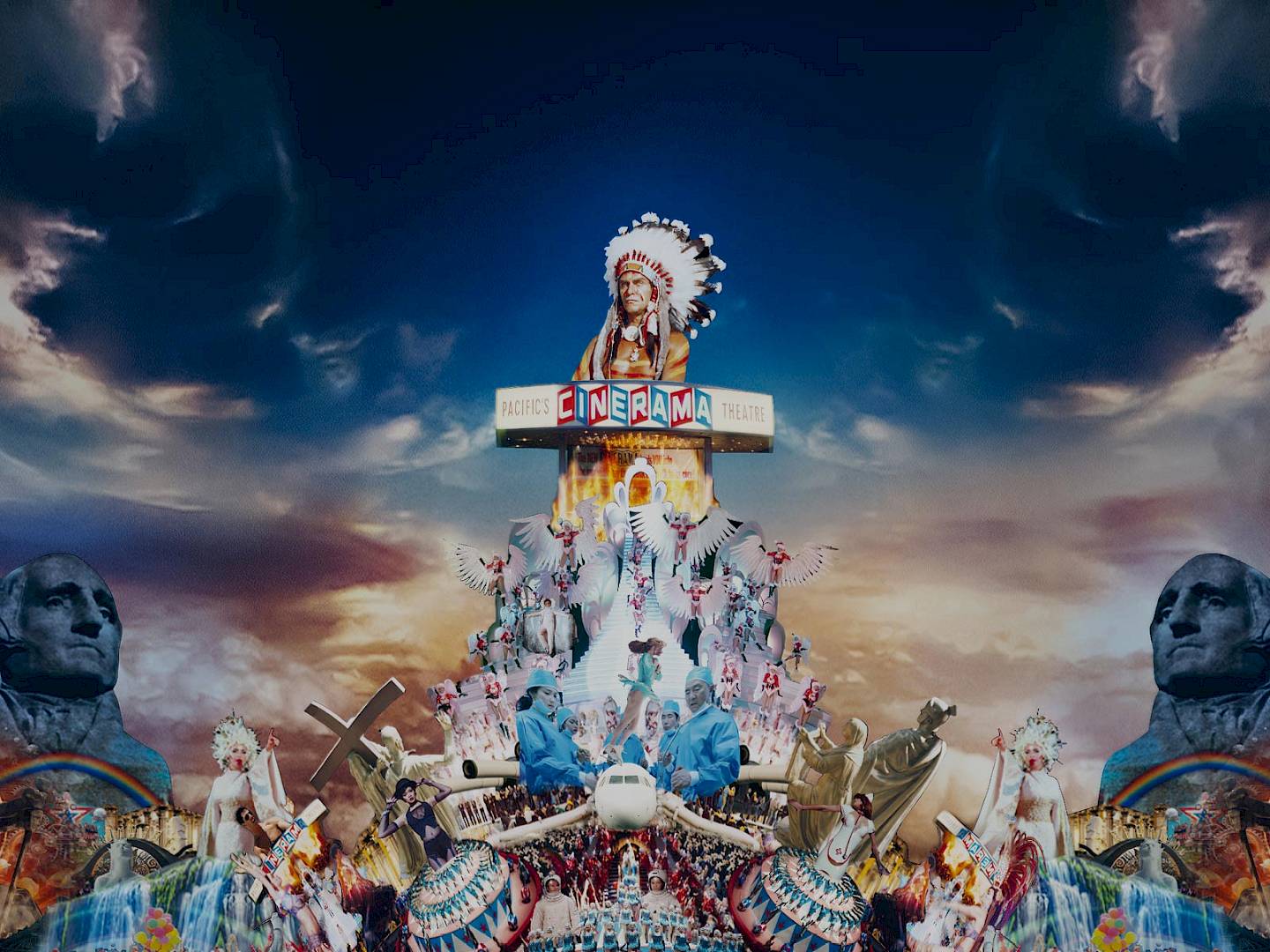
    © Poster image by Marco Brambilla (Heaven’s Gate)

Musical Director:
Titus Engel

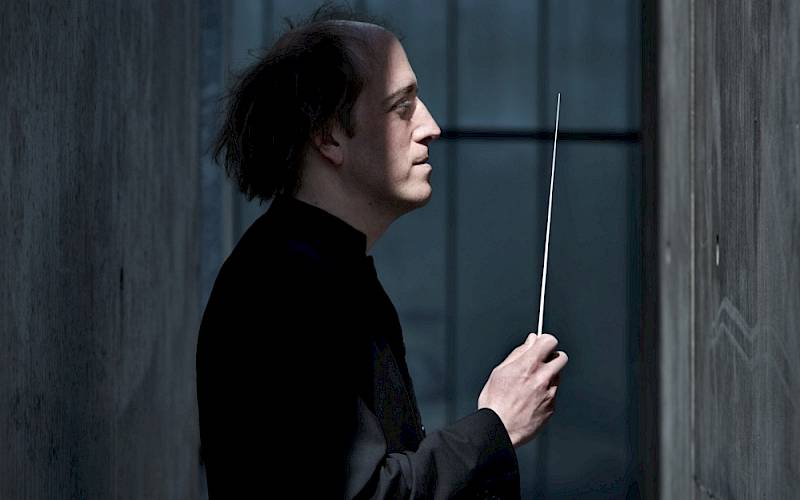
Titus Engel

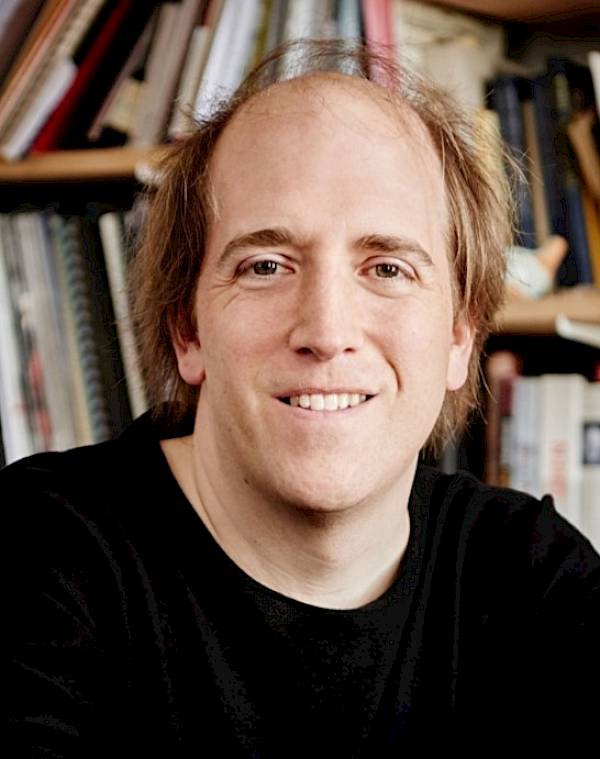
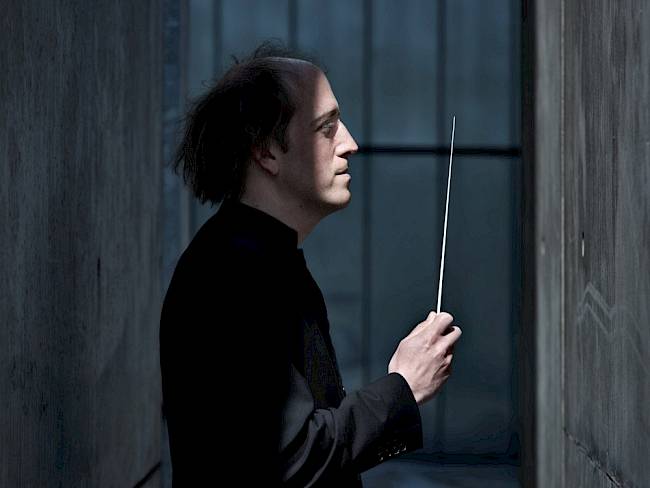
Titus Engel, born in Zurich, initially studied musicology in his hometown and in Berlin, and subsequently studied conducting with Christian Kluttig at the Carl Maria von Weber University of Music in Dresden. Engagements took him, among others, to the Stuttgart State Opera, the Frankfurt Opera, the Semperoper Dresden, the Bavarian State Opera in Munich, all three opera houses in Berlin, the Teatro Real Madrid, the Theater Basel, and the Grand Théâtre de Genève. He has conducted orchestras such as the Konzerthausorchester Berlin, the Philharmonia Orchestra London, the Mozarteum Orchestra Salzburg, the SWR Symphony Orchestra, and the Mahler Chamber Orchestra. Titus Engel has conducted numerous world premieres by composers such as Rebecca Saunders, Chaya Czernowin, Charles Wuorinen, and Olga Neuwirth. He has conducted, among others, at the Salzburg Festival, the Berlin Festival, the Lucerne Festival, the Ruhrtriennale, and at the Vienna Konzerthaus. Since 2023, he has been Principal Conductor of the Basel Sinfonietta. In 2020, he was named Conductor of the Year by the professional journal Opernwelt, and in 2025 he received the Swiss Music Prize for outstanding musical achievement. In the fall of 2025, Titus Engel was introduced as the designated member of the new musical leadership trio of the Deutsche Oper Berlin, which will take over the management of the house starting with the 2026/27 season.

Monster's Paradise8 / 14 / 18 Mar / 10 / 12 Apr 2026
Production:
Tobias Kratzer

Tobias Kratzer

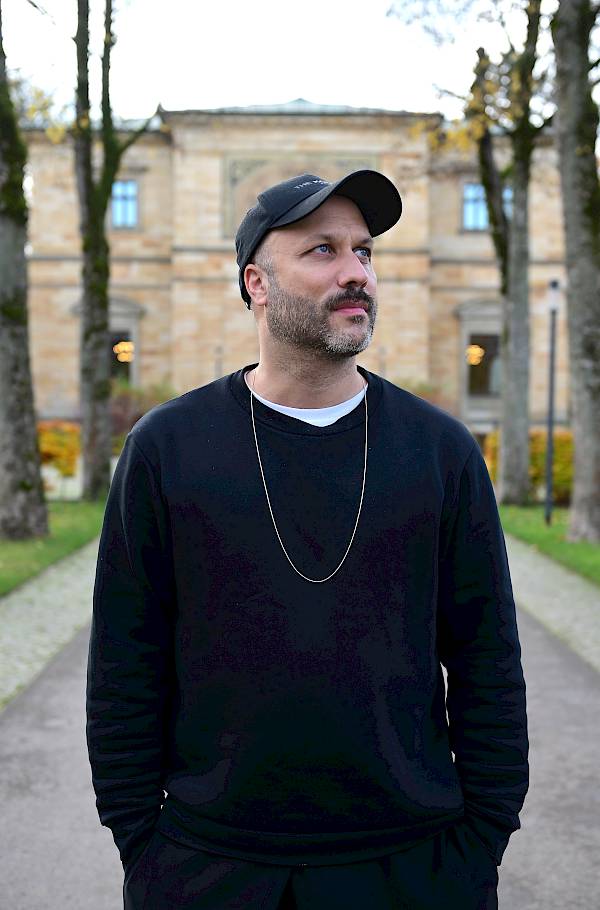
Tobias Kratzer was born in Landshut. He studied art history and philosophy in Munich and Bern, as well as acting and opera directing at the August Everding Theatre Academy. Since the 2025/26 season, Tobias Kratzer has been General Director of the Hamburg State Opera, where he has since staged Schumann’s "Das Paradies und die Peri." He has directed, among others, at the Deutsche Oper Berlin ("Der Zwerg," "Arabella," "Intermezzo," "Die Frau ohne Schatten"), at the Komische Oper Berlin ("Das Floss der Medusa"), at the Bavarian State Opera Munich (Weinberg’s "Die Passagierin," “Production of the Year” in Opernwelt), at the Oper Frankfurt ("L’Africaine," "La forza del destino," Nielsen’s "Maskerade," and Stephan’s "Die ersten Menschen"), at the Opéra de Paris (Gounod’s "Faust"), at the Royal Opera House London (Beethoven’s "Fidelio"), at the Théâtre Royal de la Monnaie in Brussels (Mozart’s "Lucio Silla" and Puccini’s "Il trittico"), at the Oper Amsterdam (Offenbach’s "Les Contes d’Hoffmann"), at the Bühnen Bern (Georg Friedrich Haas’s "Liebesgesang"), as well as at the Aix-en-Provence Festival (Rossini’s "Moïse et Pharaon") and at the Theater an der Wien ("La gazza ladra" and "Schwanda der Dudelsackpfeifer"). He is a recipient of the Ring Award 2008 and the German Theater Prize DER FAUST for his "Götterdämmerung" at the Badisches Staatstheater Karlsruhe. In 2018, he was voted “Opera Director of the Year” in the critics’ survey of the professional journal Die Deutsche Bühne, and in 2019/2020, for "Tannhäuser" at the Bayreuth Festival and Rossini’s "Guillaume Tell" at the Opéra de Lyon, he was named “Director of the Year” in the Opernwelt critics’ survey. At the Bavarian State Opera Munich, he is currently directing the "Ring des Nibelung," which began with "Das Rheingold" in the 2024/25 season.

Monster's Paradise8 / 14 / 18 Mar / 10 / 12 Apr 2026
Coproducer:
Matthias Piro

Matthias Piro

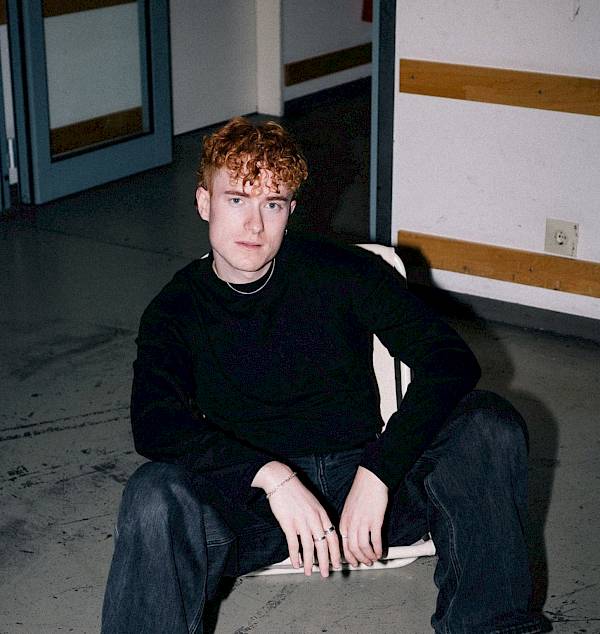
Matthias Piro, born in Saarbrücken, studied opera directing at the University of Music and Theatre Hamburg. His first directorial work took him to the Junge Oper Baden with "Don Giovanni." He worked as a freelance assistant director at, among others, the Oper Graz, the Stuttgart State Opera, the Theater an der Wien, the Théâtre Royal de la Monnaie in Brussels, as well as the Deutsches Nationaltheater Weimar and the Badisches Staatstheater Karlsruhe. He has a close collaboration with Lydia Steier, with whom he realized "The Rake’s Progress" at the Theater Basel and "Die Zauberflöte" at the Salzburg Festival. At the Lucerne Theater, he co-directed with her on "Staatstheater" and "Der Rosenkavalier." Matthias Piro regularly works as an assistant and co-director with Tobias Kratzer, including on the world premiere of G. F. Haas’s "Liebesgesang" in Bern, as well as "Die Passagierin" and "Der Ring des Nibelungen" at the Bavarian State Opera Munich. In the 2024/25 season, he directed, among others, "Die Winterreise" at the Volkstheater Rostock, "Der Triumph der Treue" at the Staatstheater Darmstadt, and "Attila" at the Heidenheim Opera Festival. In the current season, Matthias Piro serves as advisor to the General Director for the scenic department at the Hamburg State Opera.

Monster's Paradise8 / 14 / 18 Mar / 10 / 12 Apr 2026
Stage Director:
Johanna Schulz-Bongert
Sets:
Rainer Sellmaier

Rainer Sellmaier

Rainer Sellmaier, born in Munich, studied art history and theatre studies at the Ludwig Maximilian University as well as stage and costume design at the Mozarteum Salzburg. From 2006 to 2009, he was head of production at the Theater Regensburg; since then, he has worked freelance. Engagements have taken him, among others, to the Deutsche Oper Berlin, the Komische Oper Berlin, the Oper Frankfurt, De Nationale Opera Amsterdam, the Opéra de Lyon, the Royal Opera House Covent Garden London, the Vienna State Opera, the Zürich Opera House, the Opéra National de Paris, and the Bayreuth Festival. He is a member of the German Academy of Performing Arts. Since 2001, Tobias Kratzer and Rainer Sellmaier have collaborated regularly and jointly won the Ring Award in Graz in 2008. Their joint productions include, among others, "Les Contes d’Hoffmann," "L’Africaine/Vasco da Gama," "Tannhäuser," "Arabella," and "Faust." At the Hamburg State Opera, Rainer Sellmaier is designing sets and costumes in the 2025/26 season for "Das Paradies und die Peri," "Die Gänsemagd," "Monster’s Paradise," and "Frauenliebe und -sterben."

Monster's Paradise8 / 14 / 18 Mar / 10 / 12 Apr 2026
Video:
Janic Bebi,

Janic Bebi

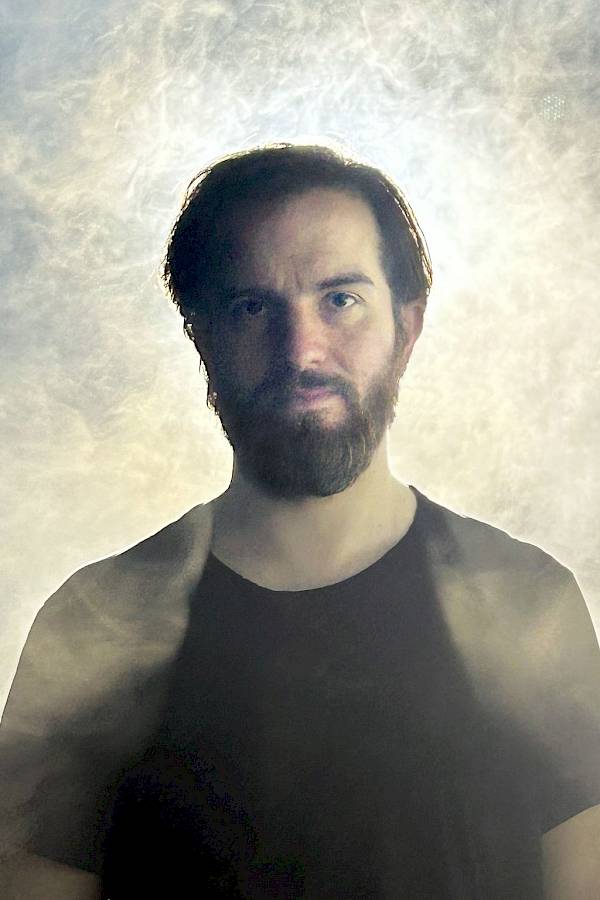
Janic Bebi, born in Switzerland, works as a visual artist and operates at the intersection of various visual media, including 3D, film, and video art. After several years as a video creator and camera operator for cultural institutions such as the Berliner Ensemble, the Komische Oper Berlin, the Stuttgart State Opera, and the VRHAM! Festival, Janic Bebi assisted at the Bayreuth Festival and the Deutsche Oper Berlin. In parallel, he developed his own artistic productions, including at the Ernst Busch Academy of Dramatic Arts, the HfMT Hamburg, and in the independent scene. Janic Bebi has worked for, among others, the Bavarian State Opera, the Deutsche Oper Berlin, the Semperoper Dresden, the Opéra National de Paris, the Teatro Regio di Torino, the Theater an der Wien, the Volkstheater Rostock, the Heidenheim Opera Festival, as well as Konzert und Theater St. Gallen. Janic Bebi maintains ongoing collaborations with Manuel Braun, Jonas Dahl, the artistic team of director Tobias Kratzer, and director Matthias Piro.

Monster's Paradise8 / 14 / 18 Mar / 10 / 12 Apr 2026
Jonas Dahl

Jonas Dahl

Jonas Dahl was born in Frankfurt am Main and studied time-based media at the Hochschule Mainz. Since 2020, he has worked as a freelance video artist. He has a close collaboration with director Tobias Kratzer and video artist Manuel Braun. Their joint productions include, among others, "Moïse et Pharaon" at the Aix-en-Provence Festival, "La gazza ladra" at the Musiktheater an der Wien, "Die Passagierin" at the Bavarian State Opera Munich, "Il trittico" at the Teatro Regio di Torino, and "Arabella" at the Deutsche Oper Berlin, for which Jonas Dahl, together with Manuel Braun, received the DER FAUST Theatre Prize in 2023. Further guest engagements have taken him to venues such as the Bühnen Bern, the Deutsches Theater Göttingen, the Opéra de Lille, the Staatstheater Mainz, and the NorrlandsOperan in Umeå, Sweden.

Monster's Paradise8 / 14 / 18 Mar / 10 / 12 Apr 2026
Lighting Design:
Michael Bauer

Michael Bauer

Michael Bauer has been Head of Lighting at the Bavarian State Opera Munich since 1998. As a lighting designer, he has created productions at many renowned venues, including the Residenztheater Munich, Den Norske Opera Oslo, Bunka Kaikan Tokyo, Royal Opera House Covent Garden London, Theater Basel, Opéra de Lyon, Teatro Arriaga Bilbao, Opéra National de Paris, Staatsoper Unter den Linden Berlin, Semperoper Dresden, English National Opera, Teatro Real Madrid, San Francisco Opera, Metropolitan Opera New York, Teatro alla Scala Milan, and the Vienna State Opera. Michael Bauer has most recently collaborated with Tobias Kratzer on "Faust" at the Opéra Bastille Paris, "La gazza ladra" and "Schwanda der Dudelsackpfeifer" at the Theater an der Wien, "Die Passagierin" and "Das Rheingold" at the Bavarian State Opera Munich, as well as "Das Paradies und die Peri" and "Monster’s Paradise" at the Hamburg State Opera.

Monster's Paradise8 / 14 / 18 Mar / 10 / 12 Apr 2026
Sound Design:
Markus Noisternig

Markus Noisternig

Markus Noisternig was born in Salzburg and completed studies in electrical engineering and sound engineering at the Technical University, as well as in computer music at the University of Music and Performing Arts Graz. He works as a computer musician and researcher, including as deputy director of the STMS laboratory, the research division of IRCAM in Paris. In addition, he teaches at Sorbonne University, the École Nationale Supérieure Louis-Lumière in Paris, the Institute for Electronic Music and Acoustics at the University of Music and Performing Arts Graz, and at the École supérieure d’art et de design in Le Mans. His artistic engagements have taken him to ensembles such as Klangforum Wien, Ensemble Modern Frankfurt, Ensemble intercontemporain Paris, and the International Contemporary Ensemble New York, as well as to opera and concert houses worldwide. For many years, Markus Noisternig has regularly collaborated as a computer musician and sound designer with composer Olga Neuwirth. Their collaboration includes numerous productions, among them the operas "Bählamms Fest," "Lost Highway," and "Orlando," as well as the orchestral works "Ce qui arrive" and "Le Encantadas."

Monster's Paradise8 / 14 / 18 Mar / 10 / 12 Apr 2026
Sound direction:
Julien Aléonard

Julien Aléonard

Julien Aléonard studied at the Paris Conservatory and specialized in music and sound engineering. He began his professional career at the research and music center IRCAM in Paris, where he worked for several years as a sound engineer. Since 2015, he has worked freelance in the fields of contemporary music, electroacoustic productions, and experimental sound projects. He has collaborated with composers such as Philippe Manoury, Luca Francesconi, Georges Aperghis, Tristan Murail, Peter Eötvös, Matthias Pintscher, Michaël Jarrell, Wolfgang Rihm, and Helmut Lachenmann, as well as with numerous ensembles and orchestras, including the Vienna State Opera Orchestra, the Gürzenich Orchestra Cologne, the Teatro alla Scala Milan Orchestra, the Orchestre de Paris, the Orchestre National de Lyon, the Orchestre Philharmonique de Radio France, and the Orchestre National de France. He served as sound director for the world premiere of Olga Neuwirth’s "Orlando" at the Vienna State Opera and for the world premiere of "Monster’s Paradise" at the Hamburg State Opera.

Monster's Paradise8 / 14 / 18 Mar / 10 / 12 Apr 2026
Dramaturgy:
Christopher Warmuth

Christopher Warmuth

Christopher Warmuth, born near Würzburg, studied music journalism, cultural and media management, and psychology. He regularly published in the arts sections of the Frankfurter Allgemeine Zeitung and the Frankfurter Allgemeine Sonntagszeitung. As a freelance music journalist, he worked for, among others, BR, DLF, and WDR in radio, as well as for print and online magazines. He was a fellow and later lecturer at the Academy for Music Journalism under the direction of Dr. Eleonore Büning. Subsequently, he worked at the Heidelberger Frühling Music Festival as head of the academies, developing the LAB, overseeing the digital strategy, and serving as advisor to the General Director. From 2021 to 2024, he was a dramaturg at the Bavarian State Opera under the leadership of Serge Dorny, with a focus on digital artistic projects, including hosting the discussion podcast "Hand aufs Hirn." In Munich, he collaborated with directors such as Christopher Rüping, Anna Bernreitner, Barrie Kosky, Claus Guth, and Tobias Kratzer ("Die Passagierin," named Production of the Year by Opernwelt 2020). Since 2024, he has taught as a lecturer at the Hamburg Theatre Academy. In 2023, he was appointed Deputy Chief Dramaturg of the Hamburg State Opera under General Director Tobias Kratzer, effective from the 2025/26 season.

Monster's Paradise8 / 14 / 18 Mar / 10 / 12 Apr 2026

Cast


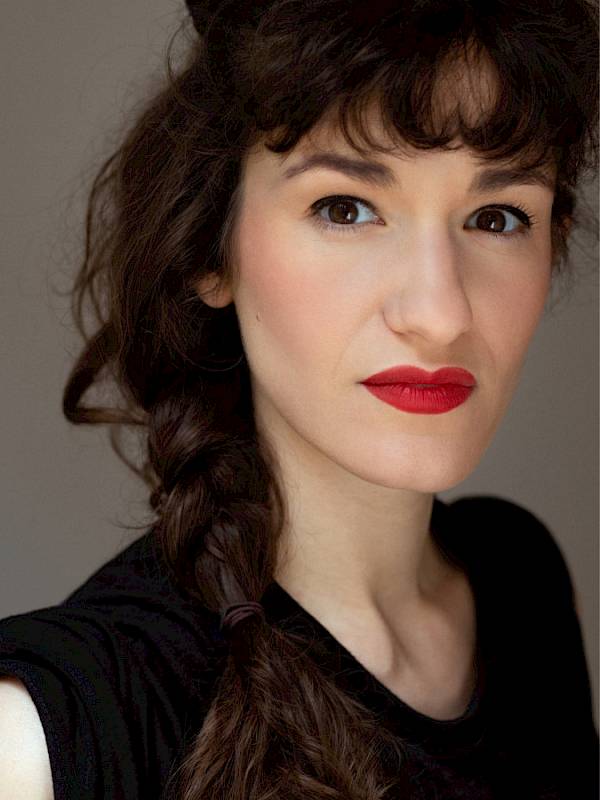
Vampi Sarah Defrise


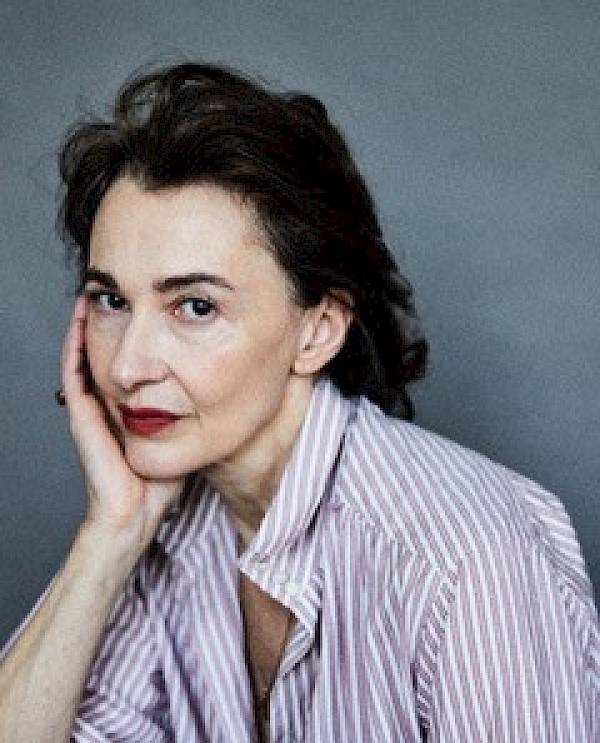
Vampi (Schauspielerin) Sylvie Rohrer


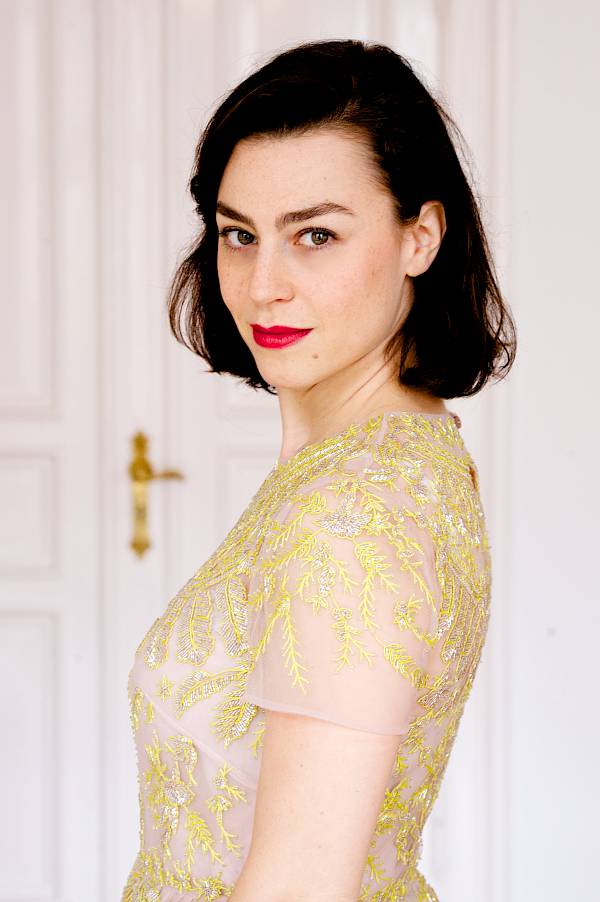
Bampi Kristina Stanek


Bampi (Schauspielerin) Ruth Rosenfeld


Der König-Präsident Georg Nigl 08 Mar / 10, 12 Apr


Der König-Präsident Robin Adams 14, 18 Mar


Gorgonzilla Anna Clementi


Mickey Andrew Watts


Tuckey Eric Jurenas


Ein Bär Ruben Drole


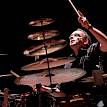
Drumkit Lucas Niggli

E-Gitarre Seth Josel

Sarah Defrise

Sarah Defrise was born in Brussels and studied voice at the Koninklijk Conservatorium there, as well as at the École Normale de Musique Alfred Cortot in Paris. In 2021, she made her debut at the Théâtre de la Monnaie in Brussels in the role of the Teenager in Jean-Luc Fafchamps’ "Is this the end?" In 2021/22, she sang The Girl in Péter Eötvös’ "Sleepless" at the Berlin State Opera and at the Grand Théâtre de Genève. At the Nouvel Opéra Fribourg, she performed in Eötvös’ "Der goldene Drache." She made her debut as Zerlina ("Don Giovanni") at the Opéra Royal de Wallonie and as Zdenka in Strauss’ "Arabella" at the Teatro Real Madrid. She returned to the Berlin State Opera as Naomi in Bernard Foccroulle’s opera "Cassandra," made her debut at the Theater an der Wien as the Virgin in Schumann’s "Das Paradies und die Peri," and at the Komische Oper Berlin as Suzanne in Offenbach’s "Robinson Crusoe." Her discography includes the solo album "For Cathy," a tribute to the singer Cathy Berberian.

Monster's Paradise8 / 14 / 18 Mar / 10 / 12 Apr 2026

Sylvie Rohrer

Sylvie Rohrer was born in Bern and attended the acting academy in Zürich. The first stages of her career included the Schauspielhaus Zürich, the Schauspielhaus Dortmund, and, from 1995 to 1999, the Thalia Theater in Hamburg. In 1995, she was named "Best Young Actress" by the magazine Theater heute, received the Boy-Gobert Prize in 1996, and in the same year was again chosen as "Best Young Actress." Since 1999, Sylvie Rohrer has been a member of the ensemble at the Vienna Burgtheater, where she has collaborated with directors such as Barbara Frey, Johan Simons, Ulrich Rasche, Adena Jacobs, Martin Kušej, and Bastian Kraft. For her roles as Medea and in Elfriede Jelinek’s "Über Tiere," she received the Nestroy Theatre Prize in 2007 in the category "Best Actress." Guest engagements have taken her, among others, to the Berliner Ensemble, including the Robert Wilson production "Shakespeares Sonette" and "Mass für Mass" directed by Claus Peymann. At the Salzburg Festival, she appeared in 2004 in Henry Purcell’s "King Arthur" and in 2010 in Jean Racine’s "Phädra." In 2026, she will return to Salzburg in "Jedermann."

Monster's Paradise8 / 14 / 18 Mar / 10 / 12 Apr 2026

Kristina Stanek

Kristina Stanek was born in Krefeld and studied at the Royal Academy of Music in London. Since the 2020/21 season, she has been a member of the Hamburg State Opera ensemble; previously, she was part of the ensembles at Theater Basel, the Staatstheater Karlsruhe, and the Theater Trier. Guest engagements have taken her, among others, to the Staatsoper Unter den Linden, the Semperoper Dresden, the Stuttgart State Opera, the Ruhrtriennale, and the Gstaad Menuhin Festival. In recent seasons, she made her debut as Kundry ("Parsifal") at the Glyndebourne Festival and as Brangäne ("Tristan und Isolde") at the Grand Théâtre de Genève. She previously made her house debut as Carmen at the Stuttgart State Opera. In the 2025/26 season, she will make her role and house debut as Charlotte ("Werther") at the Gran Teatre del Liceu in Barcelona. Her repertoire also includes roles such as Princess Eboli ("Don Carlos"), Azucena ("Il trovatore"), Orlofsky ("Die Fledermaus"), Soprano 4 in Luigi Nono’s "Al gran sole carico d’amore," and Mary Shelley in Michael Werthmüller’s "Diodati."

Monster's Paradise8 / 14 / 18 Mar / 10 / 12 Apr 2026

Ruth Rosenfeld

Ruth Rosenfeld was born in Los Angeles and grew up in New York and Tel Aviv. She initially studied electric bass and subsequently pursued vocal studies at the Rubin Academy of Music in Tel Aviv and at the Hanns Eisler School of Music in Berlin. From 2006 to 2015, she was a member of the ensemble at the Volksbühne Berlin, and since the 2017/18 season, she has been an ensemble member at the Schaubühne Berlin. She has appeared at venues such as the Berlin Philharmonie, Theater Basel, the Lucerne Festival, the Théâtre National in Brussels, the Théâtre de l’Odéon Paris, and the Schauspielhaus as well as the Zürich Opera House (2016 in Herbert Fritsch’s production of Purcell’s "King Arthur"). She has worked with directors including Frank Castorf, Herbert Fritsch, David Marton, Dimiter Gotscheff, and Jette Steckel. She was invited to the Berlin Theatertreffen with the productions "Ohne Titel Nr. 1" (2014), "der die mann" (2015), and "Pfusch" (2016), all directed by Herbert Fritsch. Her work in film and TV includes "Bibi & Tina – Voll verhext" (dir. Detlev Buck, 2014), "Piaffe" (dir. Ann Oren, 2022), and "Das Haus der Träume" (dir. Sherry Hormann, 2022).

Monster's Paradise8 / 14 / 18 Mar / 10 / 12 Apr 2026

Georg Nigl

Georg Nigl was born in Vienna. He was a soprano soloist with the Vienna Boys’ Choir and subsequently studied singing with Hilde Zadek. Guest engagements have taken him, among others, to the Berlin State Opera, the Bavarian State Opera Munich, the Vienna State Opera, Teatro alla Scala Milan, Théâtre des Champs-Élysées Paris, the Oper Amsterdam, Théâtre de la Monnaie Brussels, and the Bolshoi Theatre Moscow, as well as to the Salzburg and Aix-en-Provence Festivals, the Ruhrtriennale, and the Vienna Festival Weeks. His repertoire includes roles such as Papageno ("Die Zauberflöte"), Don Alfonso ("Così fan tutte"), Nekrotzar ("Le Grand Macabre"), and the title roles in "Le nozze di Figaro," "L’Orfeo," "Wozzeck," "Jakob Lenz," "Il ritorno d’Ulisse in patria," and Manfred Trojahn’s "Orest." Georg Nigl has earned particular recognition as a soloist and driving force behind numerous world premieres by composers including Friedrich Cerha, Pascal Dusapin, Georg Friedrich Haas, Olga Neuwirth, and Wolfgang Rihm. In 2015, he was named Singer of the Year by Opernwelt magazine. Highlights of recent seasons include the world premiere of Beat Furrer’s "Violetter Schnee" at the Berlin State Opera, Wolfgang Rihm’s "Jakob Lenz" at the Salzburg Festival, and the role of Clov in György Kurtág’s "Fin de partie" at the Vienna State Opera. In the 2025/26 season, he will sing Alberich ("Der Ring des Nibelungen") for the first time at the Vienna State Opera.

Monster's Paradise8 Mar / 10 / 12 Apr 2026

Robin Adams

Baritone Robin Adams is from England. He was a member of the ensembles at the Landestheater Linz and the Theater Bern, where he performed central roles of his fach, including Don Giovanni, Eugene Onegin, Macbeth, Wozzeck, Billy Budd, and Marcello ("La bohème"). In 2011, he made his debut as Vicomte de Valmont in the world premiere of Luca Francesconi’s "Quartett" at La Scala Milan. He has performed this role at, among others, the Vienna Festival Weeks, the Gran Teatre del Liceu Barcelona, Teatro Colón Buenos Aires, the Cité de la Musique Paris, and the Holland Festival. As a sought-after interpreter of contemporary music, he has appeared in Wim Henderickx’ "Triumph of Spirit over Matter" at Théâtre de la Monnaie Brussels, Philippe Boesmans’ "Winter’s Tale" at the Liceu Barcelona, George Benjamin’s "Written on Skin" at the Oper Köln, John Adams’ "Nixon in China" at the Concertgebouw Amsterdam, Donnacha Dennehy’s "The Last Hotel" at the Edinburgh Festival and in the Linbury Studio of the Royal Opera House London, Missy Mazzoli’s "Breaking the Waves" at Theater St. Gallen, Mark-Anthony Turnage’s "Coraline" at the Zürich Opera House, and Georg Friedrich Haas’ "Liebesgesang" at Theater Bern. More recently, he has sung roles including Alberich ("Das Rheingold") in Stuttgart and Bern, Henze’s Prince von Homburg in Stuttgart, Mandryka ("Arabella") in Bern, Messiaen’s François d’Assise in Geneva, Jaroslav Prus ("Die Sache Makropulos") in Lille, Nekrotzar (Ligetis’ "Le Grand Macabre") in Paris and Bucharest, and Wozzeck in Antwerp, São Paulo, and Beijing.

Monster's Paradise14 / 18 Mar 2026

Anna Clementi

Anna Clementi, born in Lugano, studied flute, acting, and singing in Rome. In 1986, she moved to the Berlin University of the Arts, where she studied experimental vocal music and music theatre. Her work is characterized by the search for a fusion of voice, gesture, language, dance, and theatre. Anna Clementi’s repertoire spans a wide range, from contemporary acoustic works to music theatre, electroacoustic, and club music. A central focus of her work is the music of John Cage; she has interpreted several versions of his "Song Books" and staged his works "Variations" and "Theatre Pieces." She worked closely with Dieter Schnebel and his ensemble Die Maulwerker. In addition, she has collaborated with composers such as Michael Hirsch, Rupert Huber, Iris ter Schiphorst, Laurie Schwartz, Fast Forward, and Elliott Sharp. In 2019, she performed the role of Narrator in Olga Neuwirth’s "Orlando" at the Vienna State Opera and in 2022 the role of Bartleby in Neuwirth’s "The Outcast" at the Philharmonie de Paris.

Monster's Paradise8 / 14 / 18 Mar / 10 / 12 Apr 2026

Andrew Watts

Andrew Watts was born in Middlesex, United Kingdom, and trained at the Royal Academy of Music. Engagements have taken the countertenor to, among others, the Royal Opera House London, the Glyndebourne Festival, La Scala Milan, Teatro La Fenice Venice, the Berlin State Opera, the Opéra de Lyon, as well as the Salzburg, Bregenz, Lucerne, Aldeburgh, and Edinburgh Festivals and the Ruhrtriennale. As Edgar in Reiman’s "Lear," he has performed at the Hamburg State Opera, the Opéra de Paris, the Bavarian State Opera Munich, and the Teatro Real Madrid. His repertoire includes roles such as Ottone ("Agrippina"), Athamas ("Semele"), Arsamene ("Xerxes"), Oberon ("A Midsummer Night’s Dream"), Prince Go-Go ("Le Grand Macabre"), Baba the Turk ("The Rake’s Progress"), and Orlofsky ("Die Fledermaus"). Andrew Watts has also participated in world premieres by composers including Olga Neuwirth, Harrison Birtwistle, Jörg Widmann, and Unsuk Chin. Most recently, he has appeared in Olga Neuwirth’s "Keyframes for a Hippogriff" with the New York Philharmonic, as Orlofsky at the Bavarian State Opera Munich, and in Unsuk Chin’s "Alice in Wonderland" at the Theater an der Wien.

Monster's Paradise8 / 14 / 18 Mar / 10 / 12 Apr 2026 Portrait Concert Olga Neuwirth28 Feb 2026

Eric Jurenas

Eric Jurenas, born in Fairfax, Virginia, USA, studied at the Juilliard School of Music in New York. International engagements have taken him, among others, to the Royal Opera House Covent Garden London, the Metropolitan Opera New York, the Opéra de Versailles, Oper Frankfurt, Komische Oper Berlin, Theater an der Wien, the Vienna State Opera, the Bavarian State Opera Munich, the Irish National Opera, as well as to the Handel Festivals in Karlsruhe, Göttingen, and Halle, and the Innsbruck Festival of Early Music. His repertoire includes numerous baroque roles, including the title roles in Handel’s "Giulio Cesare," "Serse," "Tolomeo," "Tamerlano," and "Rinaldo." Other roles include Natascha (Eötvös’ "Drei Schwestern"), Prince Go-Go (Ligetis’ "Le Grand Macabre"), Prince Orlofsky ("Die Fledermaus"), Peter Pan (Richard Ayres’ "Peter Pan"), and Guildenstern (Brett Dean’s "Hamlet"). Eric Jurenas has also participated in numerous world premieres, including Avner Dorman’s "Wahnfried," Donnacha Dennehy’s "The First Child," Olga Neuwirth’s "Orlando," Kevin Puts’ "The Hours," Suzanne Farrin’s "Dolce la Morte," Claire van Kampen’s play "Farinelli and the King," and Aribert Reimann’s "Sinnig zwischen beyden Welten" with Daniel Barenboim at the piano.

Monster's Paradise8 / 14 / 18 Mar / 10 / 12 Apr 2026

Ruben Drole

Ruben Drole, bass-baritone, is from Winterthur and studied at the Zurich University of the Arts. In 2004, he joined the opera studio and in 2005 the ensemble of the Zurich Opera House, where he performed roles including Lucio Cinna (J.C. Bach’s "Lucio Silla"), Haly ("L’italiana in Algeri"), Argante ("Rinaldo"), Wurm ("Luisa Miller"), and Papageno in the production of "Die Zauberflöte" conducted by Nikolaus Harnoncourt. As Papageno, he also made his debut at the Semperoper Dresden in 2015. Other projects with Harnoncourt included Kezal ("Die verkaufte Braut") and Haydn’s "Die Schöpfung" at Styriarte Graz, Beethoven’s "Christus am Ölberg" in Vienna and Lucerne, a Japan tour (Mozart’s "Requiem" and Handel’s "Messiah"), and Leporello ("Don Giovanni") at the Theater an der Wien. In the Zurich cycle of Mozart/Da Ponte operas directed by Sven-Eric Bechtolf and conducted by Franz Welser-Möst, he appeared as Guglielmo ("Così fan tutte"), Figaro ("Le nozze di Figaro"), and Leporello, the same roles he performed under Welser-Möst with the Cleveland Orchestra. At the Salzburg Festival 2012, he sang Achilla ("Giulio Cesare") and appeared in 2013 in Haydn’s "Il ritorno di Tobia" and Walter Braunfels’ "Szenen aus dem Leben der Heiligen Johanna." In Zurich, he has performed roles including Papageno ("Die Zauberflöte"), Alaskawolfjoe ("Aufstieg und Fall der Stadt Mahagonny"), Soldier ("Die Geschichte vom Soldaten"), Odysseus ("Die Odyssee"), Duchess/Caterpillar in "Alice im Wunderland," and Frank ("Die Fledermaus"). He also recently appeared in the ballet evening "Nachtträume."

Die Fledermaus7 / 10 / 12 / 14 / 18 / 26 / 28 / 31 Dec 2025 / 2 / 4 / 6 / 10 Jan 2026 Monster's Paradise8 / 14 / 18 Mar / 10 / 12 Apr 2026 Nachtträume20 / 25 / 28 / 30 Jun / 4 Jul 2026

Lucas Niggli

Der Schweizer Schlagzeuger und Perkussionist Lucas Niggli gilt als einer der interessantesten Drummer in der europäischen Szene zeitgenössischer Musik und musiziert im Grenzbereich von improvisierter und komponierter Musik. Mit verschiedenen Formationen tourt Lucas Niggli weltweit. Er ist gerngesehener Gast an den grossen Jazz Festivals in Vancouver, Berlin, Willisau, Saalfelden, Moers, Rom, Nürnberg, Capetown oder Zürich. Ebenso spielt er an grossen Festivals für zeitgenössische Musik wie Donaueschingen, Huddersfield (UK), Ultima Oslo (N) und MaerzMusik Berlin (D). Zu seinen aktuellen Formationen gehören Steamboat Switzerland, Biondini - Godard – Niggli, Kalo Yele (mit Aly Keïta) und das Duo mit dem Sänger Andreas Schaerer. Lucas Niggli führt regelmässig Werke zeitgenössischer Komponisten wie David Dramm, Michael Wertmüller, Sam Hayden, Felix Profos, Mauricio Kagel, John Cage und andere auf. In seinen Bands und Projekten arbeitete Lucas Niggli Hand in Hand mit grossen Musiker/innen wie Barry Guy, Pierre Favre, Butch Morris, Trevor Watts, Fred Frith, John Cale, Sylvie Courvoisier, Hans Koch, Peter Waters, Samul Nori, Xu Fengxia, Tom Cora, Ikue Mori, Michel Wintsch, Collegium Novum, Erika Stucky, Jacques Demierre, Arkadij Shilklopper, Jean-Luis Matinier, Irene Schweizer, Wu Wei, Phil Minton, ARTE Quartet, Flea, Andreas Schaerer und vielen anderen mehr. Lucas Niggli komponierte Werke für Chor, Orchester und kleinere Ensembles und ist als Dozent an der Zürcher Hochschule der Künste (ZHdK) tätig. Seine Diskographie umfasst 50 Titel, davon 17 CDs als Leader und Komponist, zumeist auf dem Label INTAKT Records.

Monster's Paradise8 / 14 / 18 Mar / 10 / 12 Apr 2026

Seth Josel

Seth Josel, born in New York, USA, studied at the Manhattan School of Music and Yale University. As a soloist, he performs in Europe, Japan, the USA, and Canada. He appears with orchestras and ensembles including the BBC Symphony Orchestra, the Berlin Philharmonic, Rundfunk-Sinfonieorchester Berlin, the Süddeutscher Rundfunk Choir, Staatskapelle Berlin, the Boulez Ensemble, and the Schönberg Ensemble Amsterdam, and has participated in festivals such as the Salzburg Festival, Ars Musica, Donaueschingen, the Holland Festival, the Munich Biennale, and the South Bank Festival London. From 1991 to 2000, he was a permanent member of musikFabrik. He has worked with conductors including Simon Rattle, Zubin Mehta, Kirill Petrenko, Marek Janowski, Vladimir Jurowski, Jonathan Nott, and Iván Fischer.

Monster's Paradise8 / 14 / 18 Mar / 10 / 12 Apr 2026
Show full cast Show less

Statistenverein am Opernhaus Zürich

Der Statistenverein am Opernhaus Zürich wurde im Jahr 1900 gegründet und dürfte damit einer der traditionsreichsten Vereine auf dem Kulturplatz Zürich sein. Rund hundert Frauen und Männer im Alter von 16 bis 70 Jahren bereichern das Bühnengeschehen in zahlreichen Inszenierungen.Statisten, früher auch als Figuranten bezeichnet, haben generell nicht sprechende Rollen. Ihre Einsätze am Opernhaus Zürich fallen je nach Inszenierung unterschiedlich umfangreich aus. Während früher Massenszenen im Vordergrund standen, sind die Statistinnen und Statisten seit der Ära Pereira und der Intendanz von Andreas Homoki zunehmend auch für aufwändigere Einzelauftritte sowie für anspruchsvolle technische Einsätze gefragt. Die Mitglieder des Statistenvereins üben ihre Einsätze in der Freizeit und ohne finanzielle Interessen aus. Sie bringen Begeisterung für Musik und Theater mit.

Manon24 / 27 Sept / 3 / 7 / 10 Oct 2025 La scala di seta25 / 28 Sept / 19 / 24 Oct 2025 Tosca28 Sept / 2 / 8 / 11 / 15 / 19 Oct 2025 Madama Butterfly30 Dec 2025 / 3 / 9 / 11 / 13 / 16 Jan 2026 Rigoletto20 / 23 / 27 Dec 2025 / 1 / 4 Jan 2026 Le nozze di Figaro24 / 29 Jan / 1 / 5 / 7 / 10 / 14 Feb 2026 Werther14 / 19 Jun / 1 / 4 / 10 Jul 2026 Così fan tutte3 / 7 / 9 / 12 Jul 2026 Macbeth8 / 11 / 14 / 19 / 22 / 30 Nov 2025 Arabella14 / 18 / 22 / 25 / 28 Apr 2026 Der Rosenkavalier21 / 26 Sept / 1 / 5 / 14 / 17 / 21 / 26 Oct 2025 La clemenza di Tito26 / 29 Apr / 3 / 8 / 15 / 17 / 20 / 25 May 2026 Cardillac15 / 18 / 21 / 25 Feb / 1 / 6 / 10 Mar 2026 Hänsel und Gretel16 / 20 / 23 / 28 / 30 Nov / 2 / 4 / 11 / 16 / 18 / 21 Dec 2025 / 2 / 24 / 25 / 31 Jan 2026 Carmen18 / 21 / 23 / 27 / 31 Jan 2026 Un ballo in Maschera22 / 28 / 31 May / 7 / 13 Jun 2026 Die Fledermaus7 / 10 / 12 / 14 / 18 / 26 / 28 / 31 Dec 2025 / 2 / 4 / 6 / 10 Jan 2026 Giulio Cesare in Egitto11 / 13 / 15 / 17 / 21 / 25 / 28 Mar 2026 Scylla et Glaucus27 / 29 / 31 Mar / 2 / 6 / 30 Apr / 2 May 2026 La forza del destino2 / 7 / 12 / 15 / 18 / 21 / 26 / 29 Nov / 17 / 21 Dec 2025 Sillons de Mémoires5 / 6 / 7 Feb 2026 Gianni Schicchi2 / 6 / 8 / 10 / 13 May 2026 Monster's Paradise8 / 14 / 18 Mar / 10 / 12 Apr 2026

Abstract

Olga Neuwirth is among the outstanding composers of our time. Together with the author Elfriede Jelinek, she has written a new music theatre work with "Monster's Paradise" – a political grotesque at the pulse of the present. As avatars of themselves, they send two vampiresses on a journey around the world. They observe the decline of humanity while an inflated king-president and a sea monster he himself has conjured struggle for power. The multi-award-winning director Tobias Kratzer presents himself at the Zurich Opera House for the first time with this work. At the podium is the Swiss conductor Titus Engel, who is known for his expertise in the contemporary repertoire.

Read more Show less

Trailer «Monster's Paradise»


Co-production with the Hamburg State Opera | Press reviews

«Hier wird klar, was Kunst zu schaffen vermag.»

«Eine überbordende, fantasievolle Inszenierung, die das Publikum von der ersten bis zur letzten Minute fesselt.»

«Das jüngste Werk von Olga Neuwirth und Elfriede Jelinek ist ein schriller, bitterböser Spass.»

«Zum Lachen und Weinen schön. Zum Schreien kitschig. Poetisch, rührselig, rätselhaft»

«Eine wilde, ziemlich wirre Untergangsstory, surreal und bizarr, und gleichzeitig sehr politisch»


The poster motif for “Monster's Paradise” © Marco Brambilla (Heaven's Gate)


Photo Gallery “Monster’s Paradise”


Good to know

Das Schräge verhindert, dass wir uns an das Falsche gewöhnen

Unsere Welt funktioniert zwar noch, aber so wie sie ist, stimmt sie einfach nicht mehr. Und damit wird es schräg. Nicht etwa mal kurz in der Musik, für Sekunden, sondern dauerhaft. Aus Notwendigkeit heraus. Das zueinander Verschobene ist in «Monster’s Paradise» kein Randphänomen, sondern der Grundzustand des Werkes. Gemeint ist damit nicht das radikal Andere, nicht der offene Bruch, sondern jene dauerhafte, kaum merkliche Dejustierung, bei der zwar alles weiterhin funktioniert, aber: Es passt nicht mehr. Die Welt sei aus den Fugen geraten, heisst es häufig, sie stehe am Abgrund, sie drehe durch. Gemeint ist stets dasselbe Gefühl: dass nichts mehr selbstverständlich ineinandergreift, dass vertraute Abläufe ihre innere Logik verloren haben. Und das erfahren wir über die meisterliche Kompositionsweise von Olga Neuwirth am eigenen Leib, wenn wir dieses Werk hören.

Die Geschichte von «Monster’s Paradise» ist in ihrem Kern ja bereits absurd: ein König-Präsident, ein Monster, Vampiretten, Untergang und Rettung in grotesker Eskalation. Die Grand Guignol Opéra operiert bewusst jenseits realistischer Plausibilität und nutzt das Absurde nicht als Dystopie, sondern mittlerweile als Spiegel einer entgleisten Welt. Entscheidend ist, dass die Komposition dieses Absurde nicht einfach illustriert. Die Musik entzieht der Handlung den sicheren Rahmen der Groteske und überführt es in eine permanente harmonische Schieflage. Damit wird es hörbar zu unserem Spiegel.

Schrägheit ist von Beginn an gesetzt. Das Stück eröffnet mit einer klassischen Opernfanfare – kraftvoll, eindeutig, aufgeladen –, die jedoch bereits nach wenigen Takten durch die permanent zu hoch gestimmte E-Gitarre konterkariert wird. Hinzu kommen mikrotonale Verschiebungen in den Bläsern, Vierteltöne, die nicht ornamentieren, sondern irritieren. Diese Verstimmung ist kein punktueller Effekt, sondern wie bereits erwähnt ein ganzheitliches Prinzip. Auch das Klavier ist bewusst zu tief gestimmt; die Abweichung ist präzise gesetzt, mathematisch kalkuliert, weder tonale Farbe noch spektrale Auflösung. Sie bleibt bestehen und löst sich nicht auf. Man lacht nicht über das Geschehen, sondern hört ihm zu, und dann, lacht man – und merkt anschliessend, dass etwas nicht aufgeht. Tief in einem drinnen.

In der zeitgenössischen Musik ist Musik mit Anspruch auf Witz oder Satire erstaunlich selten. Der überwiegende Teil bleibt im Grundgestus ernst. «Monster’s Paradise» stellt eine andere Frage: Wie lässt sich Witz musikalisch herstellen, ohne ihn zur Nummer zu machen?

Der Witz entsteht zuallererst durch gebrochene Wiedererkennbarkeit. Neuwirth arbeitet mit Versatzstücken aus der Musikgeschichte, die man als Hörer zwar sofort identifizieren – aber in ihrer Fülle gar nicht greifen kann: Opernfanfaren, Walzerassoziationen, Musicalidiome, Mozart- und Rossini-Gesten, amerikanische Filmmusik, bis hin zu Momenten, die an das Neujahrskonzert erinnern. Doch diese Fragmente erscheinen nie «richtig». Ein besonderer Moment ist der Beginn des 2. Bildes, wenn dem König-Präsidenten alle möglichen theatralischen Acts vorgestellt werden, die er alle wegbuzzert. Jede «Kleinkünstler:in» hat da ihre eigene Musik. Die Abfolge ist faszinierend hochtourig, es ist eine fast filmische Arbeitsweise mit sehr vielen Schnitten, was Olga Neuwirth hier zur Meisterschaft treibt.

Nun zum Orchester: Neben einem weitgehend klassischen sinfonischen Apparat, existiert eine zweite klangliche Ebene – Drumset, Saxophon, Bass- und Kontrabassklarinette sowie die verstimmte E-Gitarre und das Klavier bilden immer neue variierende bandartige Konstellationen, welche die verschiedenen Musikidiome verlangen. Im Orchester werden alle Spieltechniken der Neuen Musik abverlangt, aber nie als «l’art pour l’art», sondern immer theatralisch eingesetzt. Es wird gekratzt, geschabt, es gibt Vierteltoncluster neben romantischen Melodien. Und ein unglaublich differenziert eingesetztes Schlagzeug-Instrumentarium.

Diese Ebenen fügen sich manchmal zu einer Einheit, aber oft konkurrieren sie auch miteinander. Schmalzige Musicalmelodien tauchen auf, werden abrupt abgebrochen, kippen in Katastrophenflächen oder treiben mit enorm rhythmischem Drive voran. Gerade diese Energie ist zentral: Viele Passagen ziehen massiv, sind hochmotorisiert, beinahe überdreht. Der Drive verhindert, dass das Groteske dekorativ wird. Auch die Stimme ist in diesem Stück nie eindeutig.

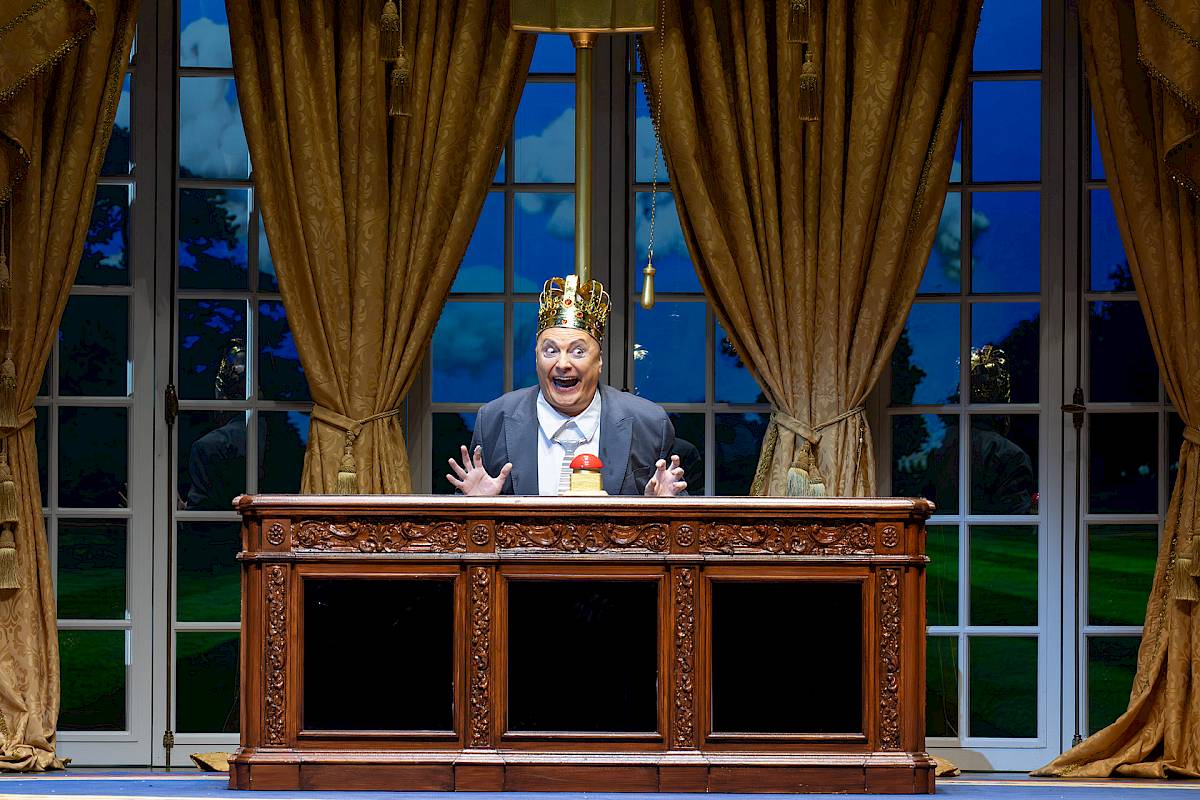
Schauspielerinnen singen, Sängerinnen sprechen. Stimmen wechseln permanent zwischen Gesang, Sprechgesang, Sprache und Effekt. Auf die Spitze treibt es der König-Präsident, er singt in allen höchsten und tiefsten Lagen, in allen Farben, senza vibrato, molto vibrato, gepresst, falsettiert, geschrien. Sein Gegenspieler Gorgonzilla spricht und singt oft in – vom Nō-Theater inspirierten – Gesang: einem Chanting, wofür Olga Neuwirth eine eigene Notation erfunden hat, aber an besonderen Stellen, wenn das Monster gut gelaunt ist, darf es auch jazzige Melodien singen. Er wird von einer Sängerschauspielerin interpretiert, deren Stimme mit Hilfe von Live-Elektronik in die Monsterstimme transformiert wird, welche die Stimme mit Harmonizern in zum Teil drei übereinanderliegende harmonisch verschobene Stimmen verwandelt.

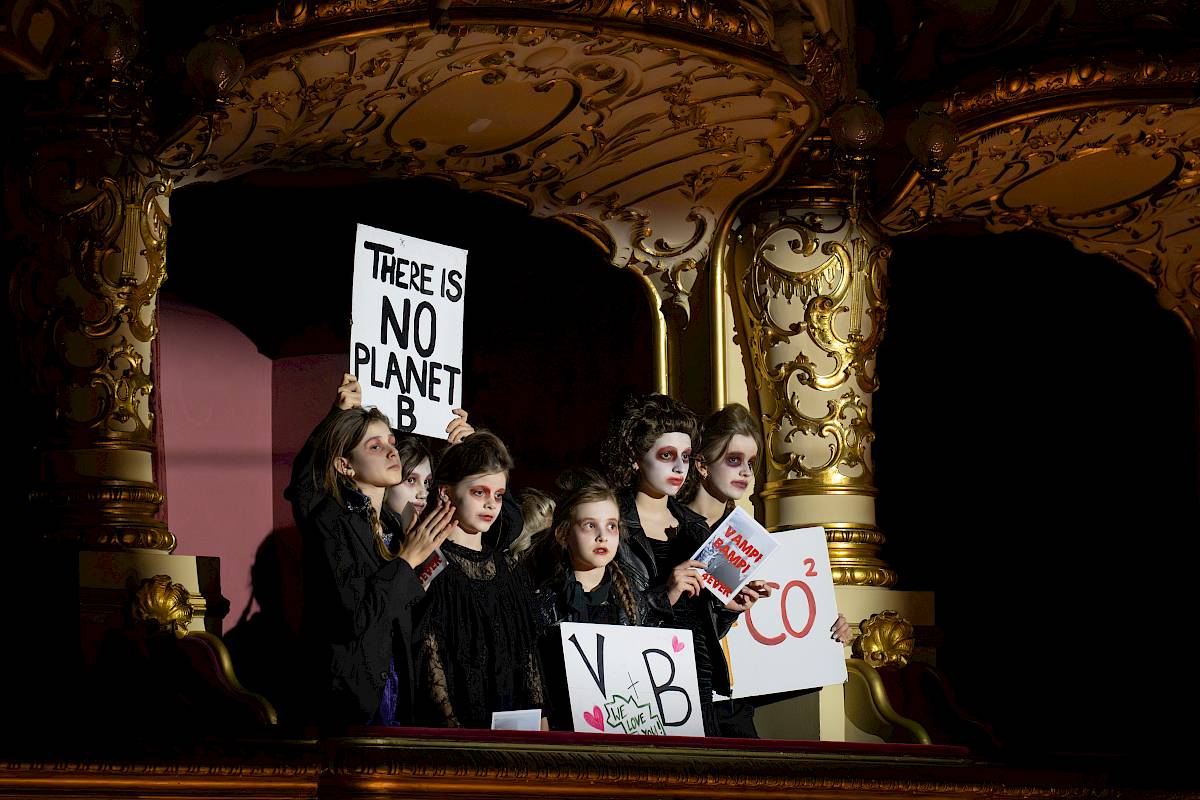
Dazu kommt ein Chor in verschiedenen Konstellationen, der manchmal sehr schön singt, aber auch summt und schreit, wie ein finnischer Schreichor. Er hat die Funktion eines griechischen Chores wie bei Bertolt Brecht. Er kommentiert und ist manchmal plötzlich doch Teil der Handlung. Die Stimme verliert ihre Funktion als stabiler Träger von Identität. Sie wird Material, Oberfläche, Störung.

Neben Orchester, Solist:innen und Chor gibt es eine weitere entscheidende Ebene: die Samples. Für Olga Neuwirth war das schon immer ein wichtiges Element. Teilweise erklingen Geräusche der Handlung, wie die Klospülung oder Rülpser des König-Präsidenten oder das Gelächter der Vampirinnen. Teilweise sind es elektronische Klangflächen für die Goddess, welche die Handlung als Gegenpart des Chores kommentiert.

Dass Olga Neuwirth all diese Ebenen in ihrem Kompositionsprozess gleichzeitig denkt, ist herausragend. Sie schreibt, im Gegensatz zu anderen, die zuerst nur die Gesangsstimmen komponieren, sofort eine unglaublich detailreich instrumentierte Partitur mit wirklich allen Anmerkungen der elektronischen Parts. Das Besondere an der Probenarbeit ist, dass sie für jedes Detail eine ganz klare Vorstellung hat und sich mit grosser Intensität dafür einsetzt, dass sie alle Wirklichkeit werden. Nicht nur hört sie genau jedes Detail in der Partitur und die Nuancierungen in den Gesangsstimmen, auch hat sie eine grosse Kenntnis der technischen Anforderungen für die Umsetzungen ihrer Samples und Effekte. Es ist ein absoluter Gewinn, sie im Probenprozess, auch am Mischpult, selbst dabei zu haben.

Ihre Energie und Konzentration zu spüren und die Gelöstheit, wenn wieder eine Etappe geschafft ist, ist ein besonderes Erlebnis für mich, ebenso wie das lockere Gespräch nach Proben, das in ganz musikferne Sphären abschweifen kann. Das macht sie als grosse Künstlerin aus, dass sie nicht nur in einem «Spezial»-Gebiet Meisterin ist, sondern einen enorm weiten Blick durch ihre lebenslange Beschäftigung mit jeglicher Form von Kultur beweist. So ist sie nicht nur eine versierte Kennerin der klassischen, romantischen und modernen Musikgeschichte, sie hat sich auch immer für das Punkige, das Anarchische und die Comic-, Pop-, und Trashkultur interessiert und verdichtet das alles in «Monster’s Paradise» zu einem Gesamtkunstwerk.

In der Verdichtung liegt die politische Schärfe der Komposition. Die Musik bietet so der Geschichte keine Entlastung. Sie erlaubt kein souveränes Lachen von aussen. Sie zwingt zur Teilnahme an der globalen Irritation, deren Teil wir auch sind. Wir können den Zustand der Welt hier in gewisser Weise körperlich erfahren. In einer Zeit, in der alles blindlings weiterläuft, global synchronisiert und technisch effizient, aber innerlich falsch, ist diese Erfahrung vielleicht die genaueste Form von Gegenwartskunst. Das Schräge wird uns nicht retten. Aber es verhindert, dass wir uns an das Falsche gewöhnen. Und darin könnte eine Rettung liegen.


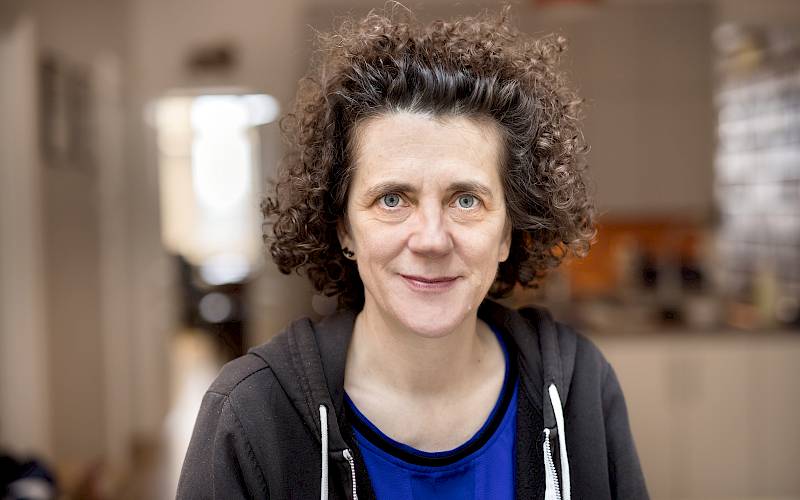
The Composer Olga Neuwirth

The Austrian composer Olga Neuwirth is among the most important voices in contemporary music. Her work combines music with literature, film and multimedia forms and includes operas, orchestral works, installations and films. The following article provides an overview of the composer’s life, influences and central works.

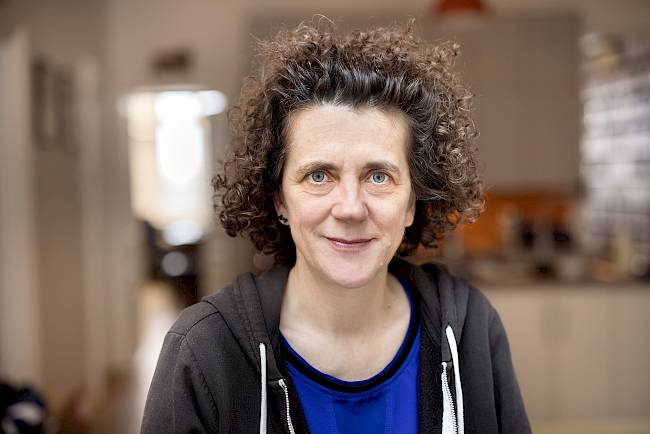
Olga Neuwirth, born in Graz, studied composition in San Francisco, Vienna and Paris, as well as painting and film in San Francisco. Important impulses for her artistic work came, among others, through encounters with Adriana Hölszky, Tristan Murail and Luigi Nono. Since 2021, Olga Neuwirth has been Professor of Composition at the University of Music and Performing Arts Vienna.

The composition of the mini-operas "Körperliche Veränderungen" and "Der Wald" (1989/1990) marked the beginning of a close collaboration with Elfriede Jelinek. Further joint projects by the two included the multimedia operas "Bählamms Fest" after Leonora Carrington (1999) and "Lost Highway" (2002/2003) after David Lynch, "Der Tod und das Mädchen II" (2000), as well as Olga Neuwirth’s film "Die Schöpfung" (2010).

Olga Neuwirth has also composed several music-theatre works, including "The Outcast" (2010/2011) after Herman Melville, "American Lulu" (2006/2011) after Alban Berg, and "Orlando" (2018/2019) after Virginia Woolf, commissioned by the Vienna State Opera. Among her other compositions are "Hommage à Klaus Nomi" (1998/2006), "...miramondo multiplo..." for trumpet and orchestra (2006), "Kloing!" for detuned self-playing piano and live pianist (2008), "Remnants of Songs – an Amphigory" for viola and orchestra (2009), and "Aello – Ballet mécanomorphe" for flute and ensemble (2018).

"Clinamen / Nodus" (2000) was premiered by the London Symphony Orchestra under Pierre Boulez, "Masaot/Clocks without Hands" (2014) by the Vienna Philharmonic under Daniel Harding, "Keyframes for a Hippogriff" (2019/20) by Andrew Watts, the Berlin Philharmonic and Jakub Hrůša, and "Zones of Blue" for clarinet and orchestra (2024) by Jörg Widmann, the Bavarian Radio Symphony Orchestra and Simon Rattle.

In 2007, Olga Neuwirth presented a sound installation at documenta in Kassel. She has received numerous prizes and honours, including the Austrian Grand State Prize for Music (2010), the Austrian Decoration for Science and Art (2019), the Wolf Prize for Music (2021), the Opus Klassik (2021), the Grawemeyer Award (2022) for "Orlando", and the Ernst von Siemens Music Prize (2022), as well as an honorary doctorate from the University of Music and Performing Arts Graz (2025).

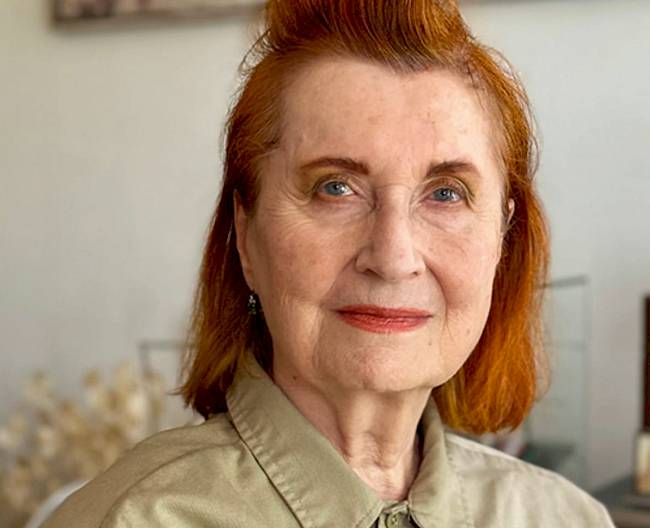
Writer Elfriede Jelinek

Elfriede Jelinek has shaped contemporary German-language literature for decades. In her novels and plays she exposes social power structures and clichés through a radical use of language. Here you can learn more about the life and work of the Nobel Prize laureate.

Elfriede Jelinek, born in Mürzzuschlag (Styria) and raised in Vienna, is one of the most important contemporary authors writing in the German language. In 2004 she was awarded the Nobel Prize "for the musical flow of voices and counter-voices in novels and plays that, with extraordinary linguistic passion, reveal the absurdity of social clichés and their dominating power".

Jelinek began her artistic career with intensive musical training and completed an early course of study at the Vienna Conservatory, where she studied piano, organ, violin, viola and recorder, graduating with a diploma as an organist. Alongside this, she studied theatre studies and art history in Vienna.

The composition of the mini-operas "Körperliche Veränderungen" and "Der Wald" (1989/1990) marked the beginning of a close collaboration with Olga Neuwirth. Further joint projects by the two included the multimedia operas "Bählamms Fest" (1999) and "Lost Highway" (2002/2003) after David Lynch.

Jelinek’s works analyse social power structures in radically sharpened language, particularly in relation to gender, sexuality, capitalism and national repression. Among her best-known novels are "Die Liebhaberinnen" (1975), "Die Klavierspielerin" (1983), "Lust" (1989), "Die Kinder der Toten" (1995) and "Gier" (2000). As a playwright she has written, among others, "Wolken.Heim", "Ein Sportstück", "Bambiland", "Das Werk", "Rechnitz (Der Würgeengel)", "Winterreise" and "Am Königsweg".
For her work Jelinek has received numerous honours, including the Georg Büchner Prize (1998), the Franz Kafka Prize (2004), the Nestroy Author Prize (2013) and the German Theatre Prize Der Faust for lifetime achievement (2017). In 2024 she was appointed Commandeur de l’Ordre des Arts et des Lettres and awarded the Grand Golden Decoration of Honour of the Republic of Austria.

Synopsis

SCENE I

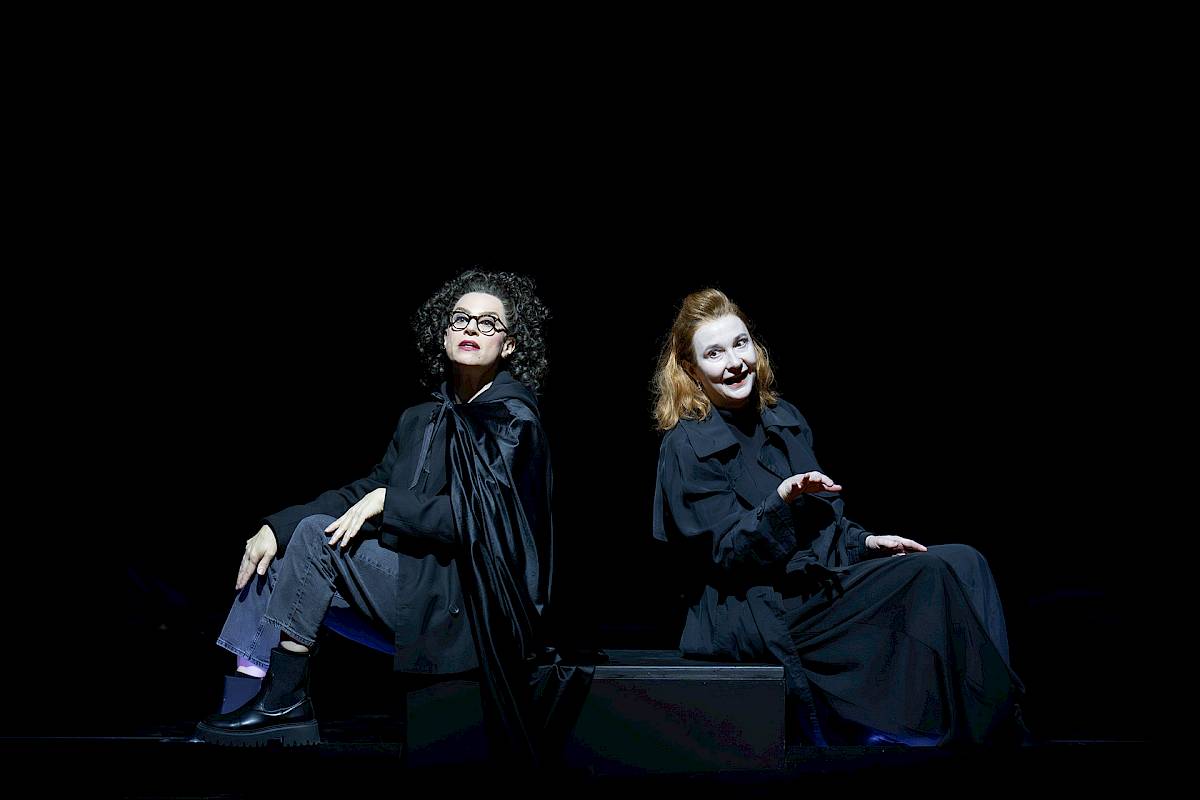
A prologue in heaven: the two "vampirettes" Vampi and Bampi hover above the fray, awaiting the end of the world, the "heat death of the universe". Like a basso continuo throughout the scene, they lament that their warnings remain unheeded, their songs unrecorded, their bodies un-noticed.

Nevertheless, the two decide to set out into the world one last time. If nothing matters anyway, they might as well try again...

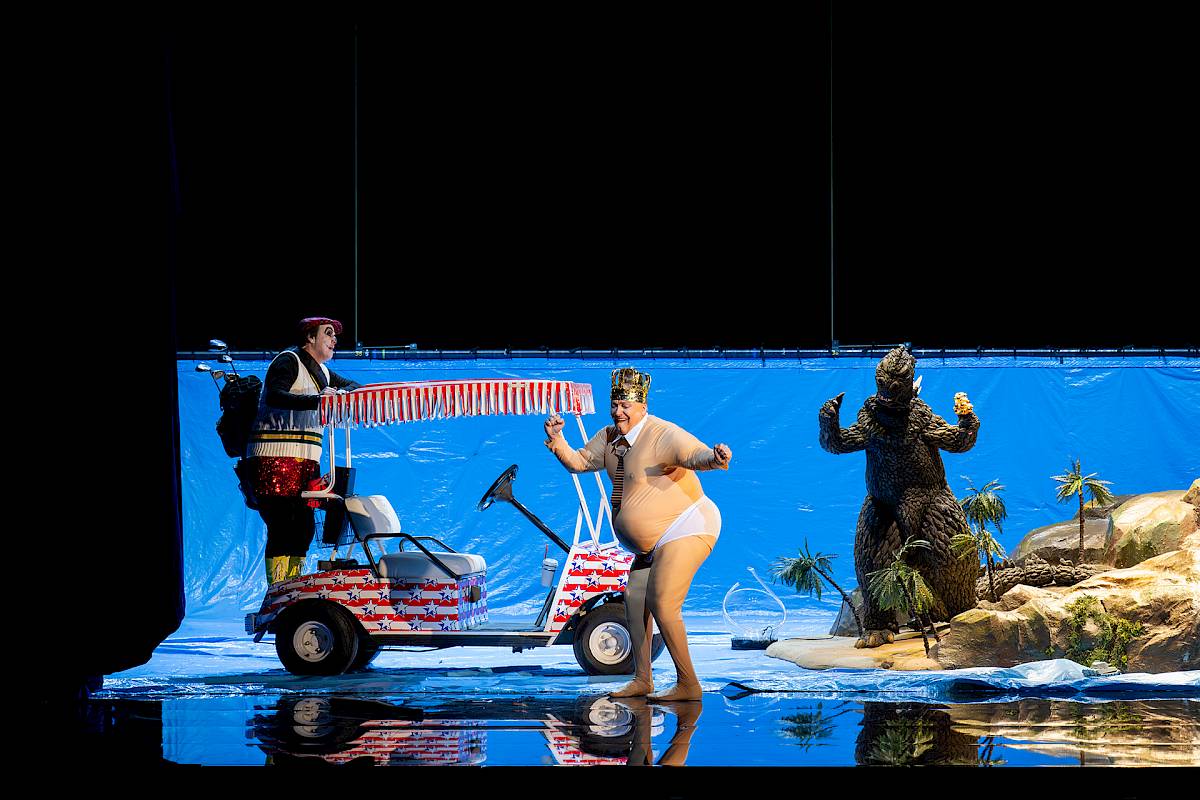
From afar, the siren song of the sea monster Gorgonzilla can be heard. Created by the explosion of a nuclear power plant, it presents itself as the saviour and patron saint of humanity.


SCENE II


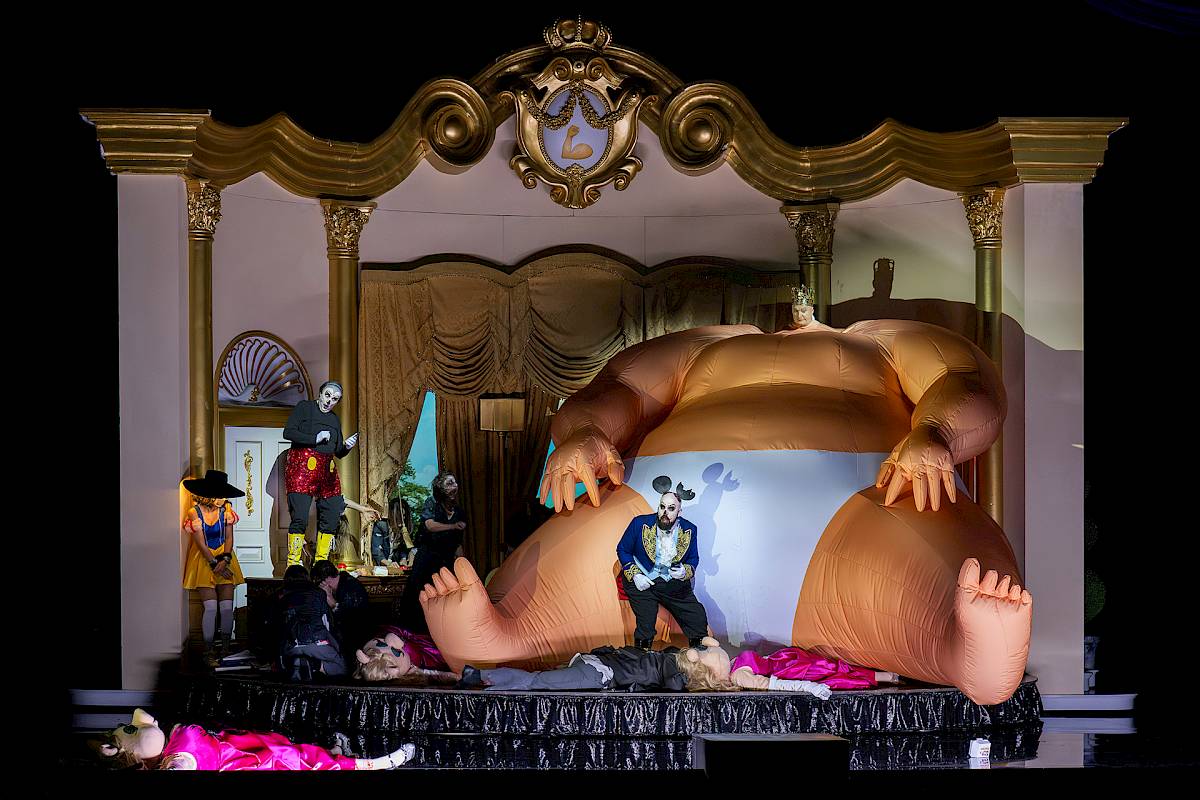
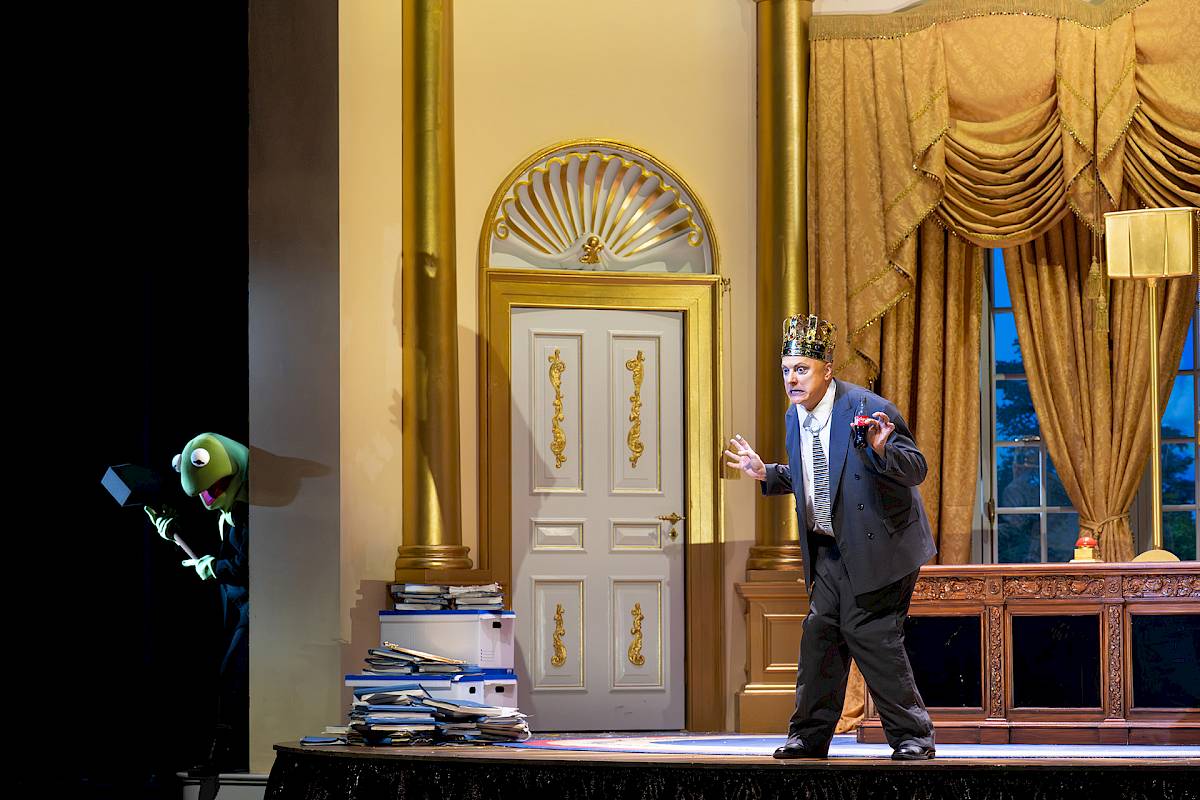
An opulent palace. The King-President, fuelled by his two servile "Adlati" Mickey and Tuckey, eagerly awaits his re-election. The Vampirettes – disguised as Miss Piggy and Kermit – try to kill the King-President, but he is indestructible.

Instead, their goal backfires into its monstrous opposite: the King-President grows to a gigantic size, whilst Miss Piggy and Kermit multiply. Under the frightened eyes of Vampi and Bampi, the newly created Kermits kill all the Miss Piggies.

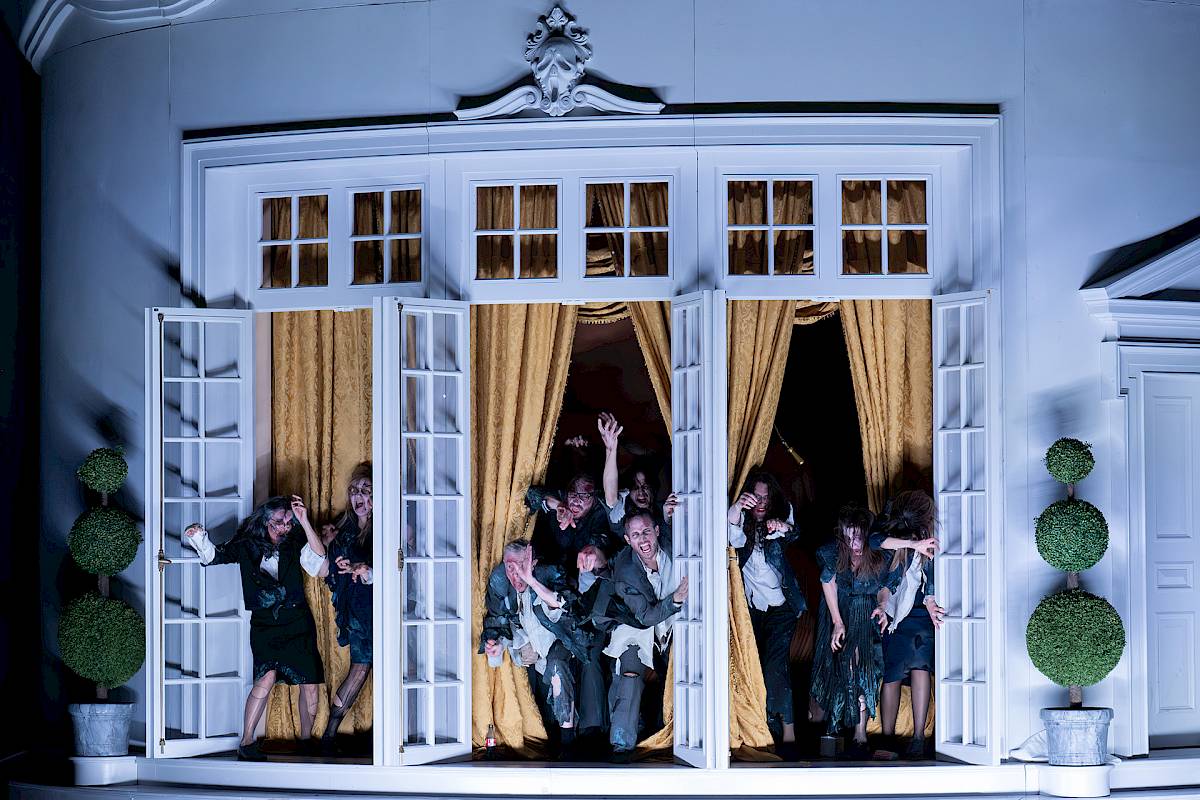
A bear delivers the compliments of the people. An unleashed mob of zombies storms the palace. From above, the repeated warning voice of a goddess is to be heard.

Gorgonzilla rescues the vampires from the general pandemonium.


SCENE III

Gorgonzilla lives on a utopian island: a refuge for all "who are peaceful and want to remain so". The monster fends off military attacks with its super-resilient powers.

The King-President visits Gorgonzilla and tries to provoke it with snide remarks, but Gorgonzilla rebuffs him and continues on its way towards the destroyed presidential palace.


SCENE IV


Vampi and Bampi wander through the world. Wars and natural disasters rage around them. The more that humans and nature rampage, the more reproachfulness and irritation arise between the vampirettes, but all shelters prove to be destroyed: "God's place is currently abandoned."

Vampi and Bampi can do nothing but watch and film with their smartphones. Arriving too late, they witness an epic battle. Amid fog and a babble of voices, Gorgonzilla and the King-President meet again and attack each other in a patriarchal show of strength.

For once, the right side seems to win. Gorgonzilla defeats and eats the president before taking his place, but the destruction has already spread. "Will this never end?"


SCENE V


Gorgonzilla has taken over. "A monster now sits on [the] throne". But saving the destroyed Earth is beyond even the sea monster's superpowers. A new humanity dawns ("Even women are now included, who would have thought it!"), and for a short time nature seems to recover; but the fire unleashed in the catastrophes of the past can no longer be contained.

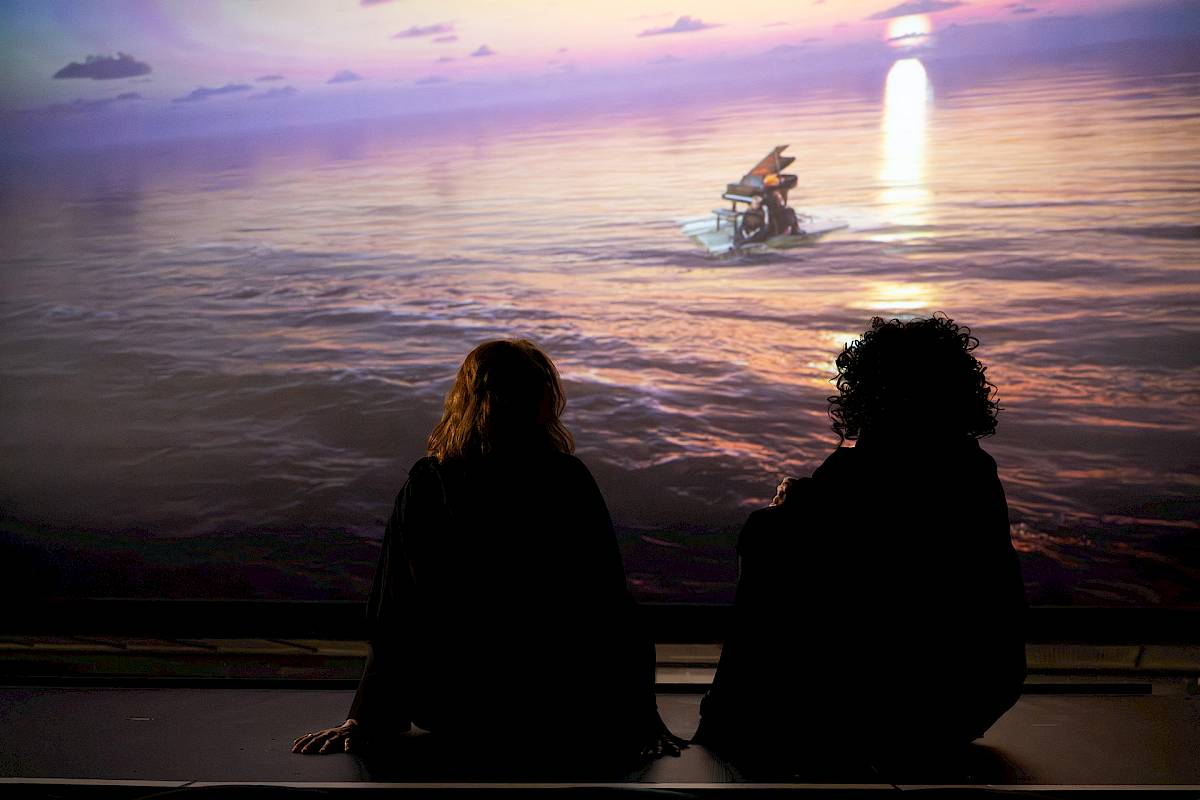
Gorgonzilla throws off its crown and takes Vampi and Bampi on its utopian escape route. As a last resort, "the ocean" beckons...

There follows a happy ending as exaggerated as the grotesque events that preceded it: although Gorgonzilla remains missing at the end, the vampires reappear on a raft. Aboard is a piano that plays "on and on". As if art might yet save us..?